Aug 18, 2026
How to Choose an Air Purifier Manufacturer in China
A reliable supplier should be able to provide consistent product performance, appropriate certifications for your target market, stable quality, reasonable customization, dependable filter supply
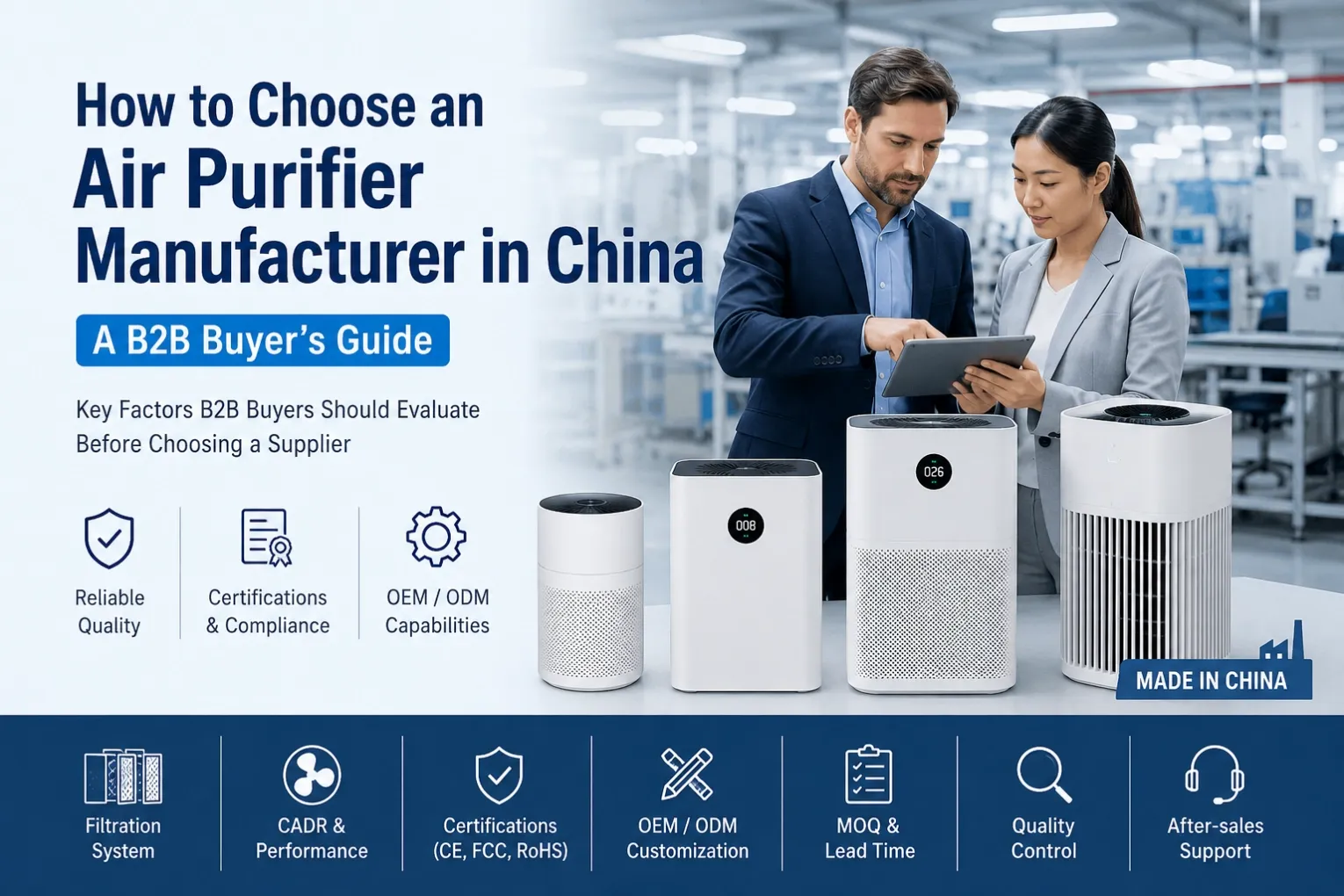
How to Choose an Air Purifier Manufacturer in China: A B2B Buyer’s Guide
China is one of the world’s major manufacturing hubs for air purifiers, offering everything from compact desktop units to high-CADR air purifiers for larger residential and commercial spaces.
For importers, distributors, wholesalers, e-commerce brands and private-label businesses, this creates plenty of sourcing opportunities.
But it also creates a challenge:
How do you choose the right air purifier manufacturer in China?
Price is important, but it should never be the only factor.
A reliable supplier should be able to provide consistent product performance, appropriate certifications for your target market, stable quality, reasonable customization, dependable filter supply and long-term after-sales support.
This guide explains the key factors B2B buyers should evaluate before choosing an air purifier manufacturer in China.
1. Start With Your Market, Not the Product
Before contacting manufacturers, define where and how you plan to sell the air purifier.
A distributor selling to hotels may need a very different product from an e-commerce brand selling compact air purifiers for bedrooms.
Consider:
- Target country or region
- Residential or commercial application
- Typical room size
- Target retail price
- Required CADR
- Noise requirements
- Filter configuration
- Smart features such as Wi-Fi or app control
- Certification requirements
- Estimated annual purchasing volume
- OEM or ODM requirements
For example, a buyer targeting hotels may prioritize quiet operation and easy filter replacement, while an office equipment distributor may care more about CADR, coverage area and maintenance cost.
The clearer your requirements are, the easier it becomes to compare manufacturers fairly.
2. Check Whether the Manufacturer Understands CADR
One of the first specifications B2B buyers should examine is Clean Air Delivery Rate, or CADR.
CADR indicates how much filtered air an air cleaner can deliver. Higher CADR generally means the unit can remove airborne particles faster and serve a larger space.
A professional air purifier manufacturer should be able to provide actual CADR data rather than relying only on statements such as:
“Suitable for 80 m².”
Ask the supplier:
- What is the tested CADR?
- Which testing method or standard was used?
- Is the result from an internal laboratory or an independent laboratory?
- At which fan speed was CADR measured?
- What room size is recommended based on that CADR?
Room coverage claims without supporting performance data can be misleading.
For B2B buyers comparing several Chinese air purifier suppliers, standardized performance data makes product comparison much more meaningful.
3. Look Beyond the Words “HEPA Filter”
Many air purifier listings advertise HEPA filtration, but B2B buyers should investigate the complete filtration system.
A typical air purifier may include:
Pre-filter
Captures larger particles such as hair, fibers and larger dust particles and can help extend the service life of the main filter.
High-efficiency particle filter
Designed to capture fine airborne particles.
Activated carbon
Used for certain gases and odors. Its effectiveness depends not simply on whether carbon is present, but also on the amount and design of the carbon media.
Depending on the application, some models may also include UV-C, ionization or other air-treatment technologies.
Ask the manufacturer for:
- Filter structure
- Filter dimensions
- Filter material specifications
- Replacement interval
- Replacement filter price
- Minimum order quantity for replacement filters
- Test reports supporting filtration claims
For distributors and brands, replacement filters are particularly important because the purifier itself may last for years while filters need to be purchased repeatedly.
4. Verify Certifications for Your Target Market
Certification requirements vary by market.
Before placing an order, tell the manufacturer exactly where the product will be sold and ask for the relevant compliance documents and test reports.
Depending on the destination and product configuration, buyers may need to evaluate requirements related to:
- Electrical safety
- Electromagnetic compatibility
- RoHS
- CE marking
- FCC
- Energy efficiency
- Ozone emissions
- Local plug and voltage requirements
Do not simply ask:
“Do you have CE?”
Instead, request the actual documentation and confirm that the model number on the reports matches the product you intend to purchase.
This becomes especially important when OEM modifications involve electrical components, motors, UV systems, control boards or other changes that could affect existing compliance documentation.
5. Pay Attention to Ozone Emissions
This is an increasingly important issue for professional buyers.
Some air-cleaning technologies, including certain ionizers, electrostatic systems, plasma technologies and UV configurations, may potentially generate ozone.
For products intended for occupied spaces, buyers should understand whether ozone is intentionally generated and whether appropriate emissions testing has been completed.
If your target market includes schools, offices, hotels, healthcare-related environments or homes, this question becomes particularly important.
Ask the manufacturer:
- Does this model intentionally generate ozone?
- Does it include an ionizer or plasma function?
- Can that function be switched off?
- Has ozone emission been tested?
- Can you provide the relevant test report?
A serious manufacturer should be comfortable discussing these questions.
6. Evaluate the Manufacturer’s OEM and ODM Capabilities
Many buyers sourcing air purifiers from China do not want to sell a completely generic product.
OEM customization may include:
- Logo printing
- Custom packaging
- User manuals
- Plug types
- Filter combinations
- Product colors
- Control-panel design
- Wi-Fi or app functions
- Private-label replacement filters
More advanced ODM projects may involve:
- Structural modifications
- New tooling
- Different motors
- Customized PCBs
- Sensor integration
- New product appearance
- Unique filtration configurations
Before choosing a supplier, ask what can realistically be customized and at what quantity.
A good manufacturer should clearly distinguish between simple OEM customization and genuine ODM development.
7. Compare MOQ Carefully
MOQ can vary significantly between air purifier manufacturers.
For a new brand testing the market, an extremely high MOQ creates unnecessary inventory risk.
But the lowest MOQ is not always the best choice either.
Ask suppliers for separate MOQs for:
- Standard product
- Logo customization
- Custom packaging
- Custom color
- App customization
- Structural modifications
- Replacement filters
This gives you a much clearer picture of the real investment required to launch the product.
For first orders, a flexible supplier that allows market testing before scaling can be more valuable than a slightly lower unit price.
8. Request Samples Before Mass Production
Never evaluate an air purifier only from photographs, videos or specifications.
Order a sample and test it yourself.
During sample evaluation, check:
- Build quality
- Plastic finishing
- Fan noise
- Airflow
- Control panel
- Sensor response
- Filter installation
- Odor from new materials
- Packaging protection
- User experience
- Power cord and plug quality
If possible, run the sample continuously for several days.
You should also compare the sample against the specifications provided by the supplier.
A beautiful product photograph tells you very little about what happens after the machine has been running for hundreds or thousands of hours.
9. Ask About Quality Control
Consistency is one of the biggest concerns in B2B sourcing.
A good sample does not automatically guarantee that 500 or 5,000 units will have the same quality.
Ask potential manufacturers about their quality-control process.
Important questions include:
- How are incoming components inspected?
- Is every finished unit function-tested?
- Is electrical safety testing performed during production?
- Are motors tested?
- Are sensors calibrated or checked?
- Is there an aging test?
- What is the inspection standard before shipment?
- Can third-party inspection be arranged?
For larger orders, buyers may also consider pre-shipment inspections by an independent inspection company.
10. Evaluate Noise, Not Just Maximum Airflow
Air purifier specifications often emphasize maximum CADR.
But users rarely operate a noisy machine at maximum speed all day.
For hotels, bedrooms, offices, schools and other occupied spaces, acoustic performance can be just as important as airflow.
Ask for noise data at:
- Sleep mode
- Low speed
- Medium speed
- Maximum speed
Then consider the relationship between noise and CADR.
A well-designed air purifier should deliver useful airflow without becoming unnecessarily disruptive.
11. Understand the Total Cost of Ownership
The purchase price of an air purifier is only one part of its real cost.
B2B buyers should calculate:
Product cost + shipping + duties + replacement filters + energy consumption + warranty cost + after-sales service
Replacement filter pricing deserves particular attention.
Imagine two suppliers:
Supplier A offers a purifier for $5 less but replacement filters are expensive and difficult to obtain.
Supplier B has a slightly higher unit price but maintains stable filter production and competitive replacement-filter pricing.
For a distributor building a long-term product line, Supplier B may create much better economics.
Always think beyond the first container.
12. Check Replacement Filter Supply
This issue is often underestimated.
Air purifier customers will need replacement filters months or years after the original purchase.
Ask the manufacturer:
- How long will this filter remain in production?
- Can replacement filters be ordered separately?
- What is the MOQ?
- Can filters carry our brand?
- Can we stock filters together with the first shipment?
- What happens if the purifier model is discontinued?
For a serious air purifier brand, filter supply is part of the product — not an accessory.
13. Evaluate Communication Speed and Technical Knowledge
You can learn a lot about a supplier before placing an order.
Send several technical questions.
For example:
“What CADR would you recommend for a 60 m² office?”
“What is the difference between these two filter configurations?”
“Can you provide ozone emission data?”
“What happens to the certification if we modify the PCB?”
“Can you recommend a quieter configuration for hotel rooms?”
Pay attention to the answers.
A supplier that only responds with price lists may be fine for simple transactions.
But if you are building a long-term air purifier business, you need a supplier that can help solve problems.
14. Factory or Trading Company: Does It Really Matter?
Many importers automatically assume that working directly with a factory is always better.
Not necessarily.
Factories may offer:
- Better manufacturing control
- More direct engineering communication
- Stronger customization capabilities
- Potential cost advantages at larger volumes
Professional trading or sourcing companies may offer:
- More product options
- Lower initial quantities
- Better communication
- Easier consolidation
- More flexible sourcing
The more important question is:
Can this supplier consistently deliver the right product, quality, documentation, price and service for your business?
Business reliability matters more than the label on the company.
15. Visit the Factory or Conduct a Video Audit
For larger orders, consider visiting the manufacturer in China.
If visiting is not practical, request a live video factory tour.
Ask to see:
- Production lines
- Assembly stations
- Testing equipment
- Warehouse
- Filter storage
- Aging-test area
- Packaging area
- Quality-control procedures
A live video call is much more useful than a polished factory video.
For significant projects, a third-party factory audit can provide additional verification.
16. Compare Suppliers With a Scorecard
Instead of choosing based on intuition, create a simple supplier scorecard.
Evaluation Area | Suggested Weight |
|---|---|
Product performance | 20% |
Quality & reliability | 20% |
Certification & compliance | 15% |
Price | 15% |
OEM/ODM capability | 10% |
MOQ flexibility | 5% |
Replacement filter supply | 5% |
Communication | 5% |
Lead time | 5% |
This prevents price from dominating the decision.
The cheapest supplier is rarely the cheapest supplier after quality problems, returns, delays and lost customers are included.
Questions to Ask an Air Purifier Manufacturer Before Ordering
Before placing your first order, ask:
- What is the tested CADR of this model?
- What filtration configuration does it use?
- Can you provide performance test reports?
- Which certifications are available?
- Are those reports valid for the exact model offered?
- Has ozone emission been tested?
- What is the noise level at each fan speed?
- What is the MOQ for standard and customized orders?
- What OEM and ODM options are available?
- What is the sample lead time?
- What is the mass-production lead time?
- What quality-control procedures are used?
- What is the warranty policy?
- How are defective units handled?
- What is the replacement filter price and MOQ?
- How long will replacement filters remain available?
- Can third-party inspection be arranged?
- Can you support different plugs and voltages?
- Can packaging and manuals be customized?
- What information do you need from us before recommending a model?
Red Flags When Choosing an Air Purifier Supplier
Be cautious if a supplier:
- Cannot provide basic product test data
- Makes exaggerated purification or health claims
- Cannot explain CADR clearly
- Avoids questions about ozone
- Provides reports with inconsistent model numbers
- Changes specifications frequently
- Offers an unusually low price without explanation
- Cannot provide stable replacement filters
- Pushes for a large order before sample testing
- Gives vague answers about warranty or quality control
A professional supplier does not need to have the lowest price.
It needs to make your purchasing decision easier and your business risk lower.
Final Thoughts
Choosing an air purifier manufacturer in China should not be a simple price comparison.
The right supplier should understand your target market, provide verifiable performance data, support the required compliance documentation, maintain stable quality and continue supplying replacement filters after the initial order.
For B2B buyers, the goal is not simply to purchase an air purifier.
The goal is to build a product line that your customers can trust and that your business can sell profitably for years.
Before requesting a quotation, prepare three pieces of information:
1. Your target market
2. Your application or room size
3. Your estimated order quantity
With these details, an experienced supplier can recommend the appropriate CADR, filtration configuration, product size and customization options.
Looking for an Air Purifier Manufacturer in China?
Purevoratech provides air purification solutions for importers, distributors, wholesalers and private-label brands.
We support a range of OEM and ODM requirements, including product selection, filtration configurations, branding, packaging and market-specific customization.
If you are developing an air purifier product line or sourcing for a commercial project, send us:
Target country + application + room size + estimated quantity
Our team can help you evaluate a suitable air purification solution for your market.
Contact Purevoratech for product specifications, OEM options and B2B quotations.